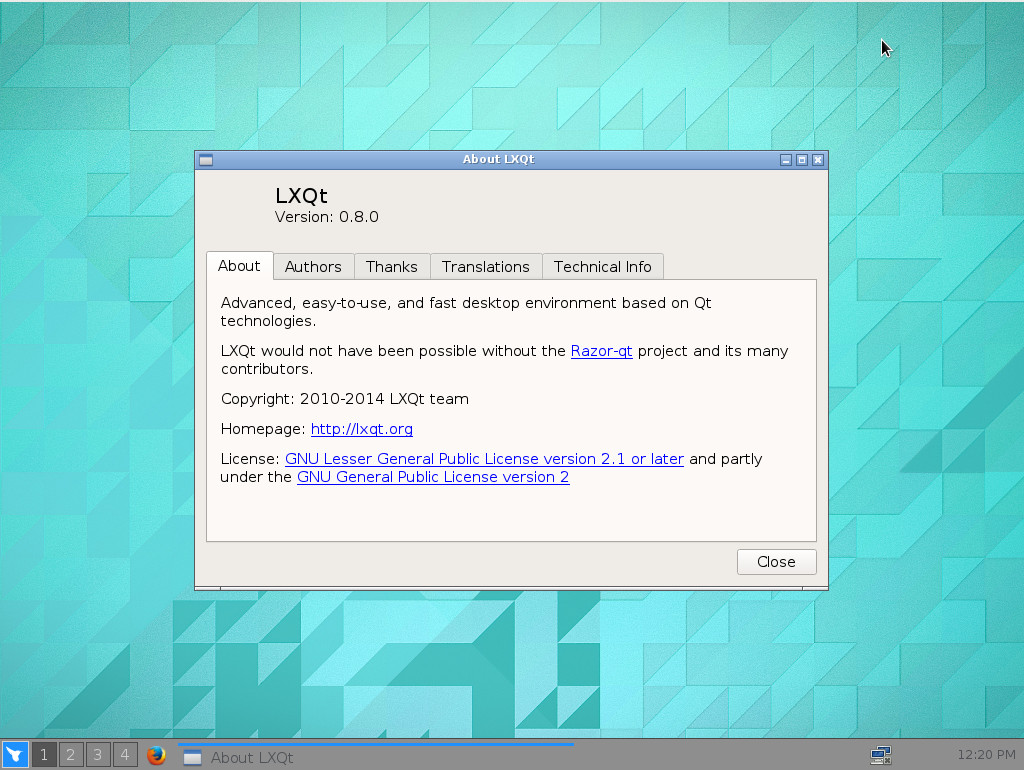
LXQt 0.8.0 has just been released (yesterday) and it brings performance improvements, new features, bugfixes and more with it. Here's what you get.
LXQt is the Qt port and the upcoming version of LXDE, the Lightweight Desktop Environment. It is a lightweight, modular, blazing-fast and user-friendly desktop environment, brought by the joint efforts of both LXDE and Razor-Qt projects.
In this version you'll find many improvements, including some new features and plenty of bug fixes. Following is a list of the most notable changes.
LXQt 0.8 Feature Highlights
- Full Qt 5 support
- New component: lxqt-admin - brings an optional set of basic admin tools
- New themes - Plasma Next and Dark Alpha
- pcmanfm-qt improvements - support for single-click to activate items, support for drag & drop on the desktop, and more...
- lxqt-panel improvements - support for reordering of taskbar buttons, and more...
- Integrate with compton if available (disabled by default)
- Lots of performances improvements
- Lots and lots of bugfixes
Certainly, a decent list of changes that justify an upgrade you might say, however, as it turns out the road for upgrading is not that simple (yet).
Upgrading / Installing LXQt 0.8
In case you feel an itch to go and give LXQt 0.8 a try, you might encounter a few obstacles along the way, as I did. Nonetheless, here's how to overcome some of them and reach a working state of the DE.
After installing LXQt 0.8 on both Ubuntu and Arch separately, I've come to the conclusion that although version 0.8 was announced as stable - some bugs, or perhaps inadequate maintenance will be present and may hinder your experience.
Hence, I'll elaborate on how to install LXQt 0.8 on Ubuntu (Archers, I expect you to handle this on your own), however the workaround suggestions will be targeting both. Here it goes:
Open up
Ubuntu Software Centre > click on
Edit from the top bar menu > and select
Software Sources.
Next switch to
Other Software tab > and click
Add button to the bottom left of the window. Enter
ppa:lubuntu-dev/lubuntu-daily and click
Add Source.
On latest versions of Ubuntu this should prompt you to update (repository) database automatically and you should accept.
Yet just in case, in order to do it manually, simply open terminal and type:
sudo apt-get update
Now, you may use Terminal or Software Center, whichever you feel comfortable with, and install the package
lxqt-metapackage. This will install all of the necessary dependencies as well.
Logout and upon login back, after typing your password click on the Ubuntu symbol next to your user in order to choose LXQt-desktop from the list. Now login.

First Impression & Workarounds
Upon first login, you might be greeted by a blank black screen (Ubuntu), or a prompt message asking to select a default WM (Window manager), or both.
In the case of a blank screen, you'll note that although the panel isn't showing it's still there nonetheless. For instance, try clicking on the left lower corner where you'd usually find the "start-menu" button - the menu will show up!
To bring the panel to forefront press Alt + F2 keys and run the command:
lxqt-panel -r which basically tells the OS to replace it.
In order to make the panel show permanently, click the start button and go into:
Preferences >
LXQt System Settings >
Session Settings > select
Autostart from the left pane > press
Add button > press
Search button > choose
lxqt-panel > name it
LXQt-Panel > click
OK.
About the ugly background, whether it's black, green or whatever, simply choose a different background as you would normally from the system / desktop appearance settings.
Lastly, regarding the prompt for selecting a WM, click on the Search button > and choose mutter / kwin / compiz / etc... if you already have one of them.
Note: by default LXQt opt for Openbox, though if it's not available you'll see that message prompting you to select a WM, thus you might want to install Openbox and then choose it as default.
Tip: The reason why LXQt background wasn't recognized initially is because it's looking for it inside /usr/share/lxqt-qt5 but there isn't one there.
Therefore, I suggest you copy the folders from /usr/share/lxqt into /usr/share/lxqt-qt5 in order to prevent any other compatibility issues you may encounter in the future.